
For the week including October 15, 2010
THE SERPENT BEARER
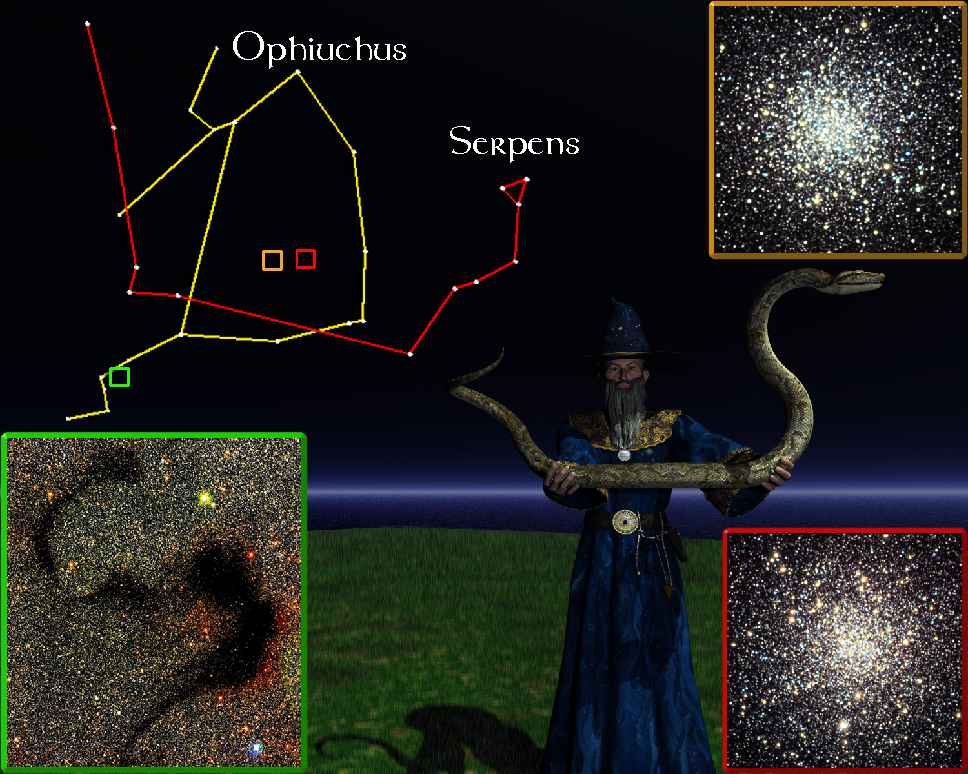
Look to the southwest after sunset and close to the horizon you will see the strange constellation of Ophiuchus, the Serpent Bearer. Here we find the two constellations sharing the same portion of sky, Ophiuchus and Serpens. Highlighted in red in our illustration, Serpens, the Snake, is often divided into two star groups on either side of the body of Ophiuchus, Serpens Cauda (the snake’s tail) at the left and Serpens Caput (the snake’s head) at the right side.
Here are just a few of the region’s attractions:
The Snake Nebula (lower left): The American astronomer Edward Emerson Barnard made a name not only for himself but for a whole class of objects when he took to the study and research of dark nebulae. While most astronomers were trying to find things in our galaxy that were bright enough to see in their telescopes, Barnard was fascinated by the places in the sky that showed dark voids where stars should have been visible. He found that although there really were stars in these places, they were being obscured by huge clouds of gases and dust that did not allow starlight to get through. As the Canada-France-Hawaii Telescope photograph shows, the Snake is one of the more beautiful examples included in his 1919 book, Catalogue of 182 Dark Markings in the Sky.
Catching the Snake with a telescope requires a clear, cloudless night when the Moon is not visible. The reasoning behind these preconditions is that observers are not used to looking for dark objects in the blackness of space and so a strong amount of visual contrast is needed to pick out Barnard’s cloud against its starry backdrop.
While exploring Ophiuchus in 1916 Barnard discovered an unusual stellar member now called Barnard’s Star -- a runaway that’s travelling through our galaxy at some 90 miles a second. Photographs taken of it each year show Barnard’s Star to have wandered a considerable distance compared to adjacent stars. This apparent movement, called proper motion, is actually an illusion caused by the Earth’s orbit affecting our line-of-sight view of nearby stars. As we move, the apparent space between an object on the horizon and one near us seems to widen. So it is as we look at Barnard’s star which is by fairly close by (11.2 light years) compared to the much more distant stars that form its backdrop.
M10 (upper right): Over 100,000 stars are packed into this globular cluster and we can only imagine what our night sky would look like if we lived on planet orbiting a star near its core. There would be so many bright stars around us that the darkness of night would probably be an unknown event.M12 (lower right): This globular cluster which holds many thousands of stars was discovered by Charles Messier in 1764 and lies some 18,000 light years away.
M10 and M12 are easily found with binoculars and are so close together (about 2,000 light years separate them) that they may actually orbit a common center of gravity.
M10 Photo Credit: Michael and Michael McGuiggan/Adam Block/NOAO/AURA/NSF
M12 Photo Credit: Michael Gariepy/Adam Block/NOAO/AURA/NSF
Unless otherwise indicated, all content of this web site is the copyright of Robert Deegan and all rights are reserved.
For more information, or to comment, please contact: Bob@NightSkies.org