
For the week including October 8, 2010
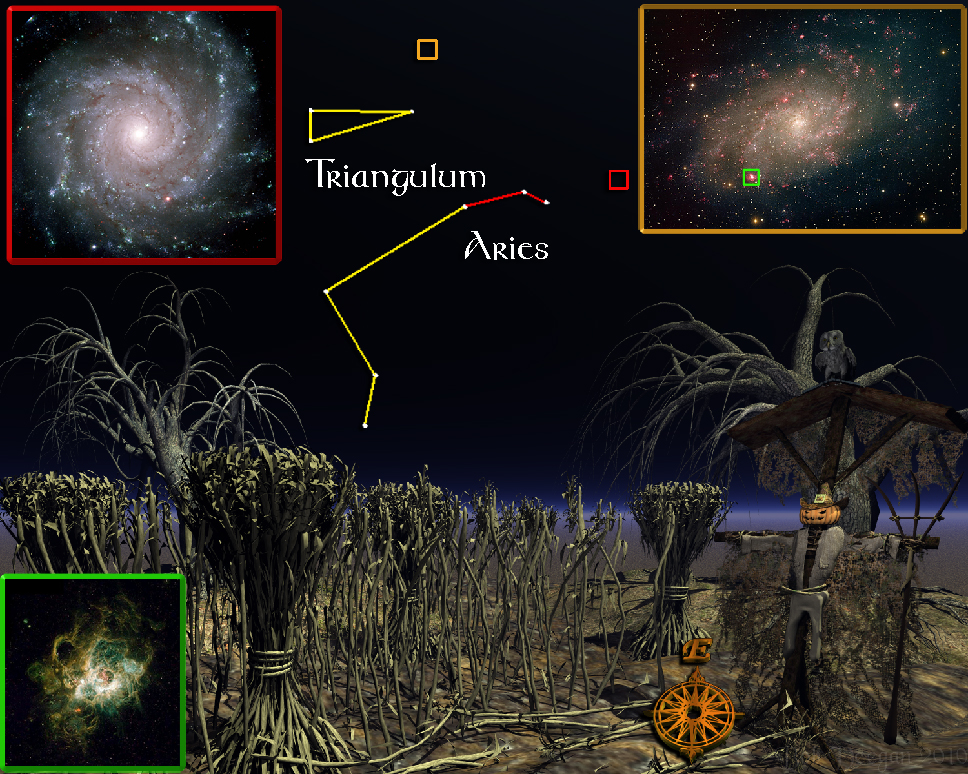
PINWHEEL GALAXIES
After the Sun goes down, three bright stars forming a hockey stick pattern appear above the eastern horizon. These stars are the most prominent and uppermost members of the constellation of Aries, the Ram. This constellation has been handed down to us from the ancient Greeks and their legend of Jason’s quest for the Golden Fleece. The fleece was said to have had wondrous and magical powers but the ram that wore it was not too keen on giving it up. The ram lived at the end of the Earth and was guarded by fierce monsters, but Jason eventually succeeded in winning it. At the conclusion of this epic adventure, the gods placed the fleece among the stars as the constellation of Aries. Nowadays the Ram helps us find two of the finest “pinwheel” galaxies visible from Earth.
M74: This strikingly beautiful galaxy can be found with a backyard telescope simply by scanning across to the right of Aries’ hockey stick. Shown in the Gemini Observatory photograph at upper left, M74’s well-defined spiral arms are spread across 95,000 light years of space. At a distance of 35 million light years, it takes a very good telescope to see that its arms are well populated with brilliant concentrations of very young stars.
M33: Look up and to the left of the hockey stick of Aries and you will come to a triangular group of stars called Triangulum, the Triangle. And they say astronomers have no imagination! This may seem a little superfluous in that any three unaligned stars could be made into a triangle, but these stars are pretty bright and are readily distinguished from their surroundings. It’s here in the constellation of Triangulum that we find, M33, the biggest and the brightest of the pinwheels. If you have binoculars or a telescope, it shouldn’t take long to search out M33 off the point of the Triangle. Just visible to the naked eye on very clear, dark nights, it appears as a large, smoky blur of light in binoculars. Shown in the National Optical Astronomy Observatory photograph at upper right, M33 is one of the larger members of our Local Group of galaxies. Its thick spiral arms measure about 60,000 light years across. Even though M33 is over 3 million light years away, a strong backyard telescope can pick out some of its individual star forming regions. The Hubble Space Telescope recently explored one of these regions, the bright knot visible at the upper left edge of the galaxy. The view from the Hubble is shown at lower left. It turned out to be a huge cloud of ionized hydrogen measuring over 1,500 light years in diameter. The gases are glowing with the radiation thrown off by over 200 hot, giant stars that recently formed in the cloud.
Before you put your telescope away, there’s another attraction to see in this area of sky. You might like to train your sights on Mesartim, the rightmost star in the hockey stick asterism. This is actually a wonderful blue/white double star system whose components orbit a common center of gravity.
Unless otherwise indicated, all content of this web site is the copyright of Robert Deegan and all rights are reserved.
For more information, or to comment, please contact: Bob@NightSkies.org