
For the week including October 22, 2010
THE CHARIOTEER
Each year, as baseball’s World Series of comes around, a constellation rises that bears a striking resemblance to home plate. Next time you’re out for an evening walk, you might think of bringing along a pair of binoculars to explore these bright stars of the northeast.
The constellation of Auriga, the Charioteer, is named for a very hazy character in Greek mythology who is always described as a goatherd. His legend never mentions anything about chariots so why Auriga is called the Charioteer is anybody’s guess. There are many instances among the stars where the folk myths of different cultures are woven together. Sometimes the mixing is smooth, other times, like in this constellation, stargazers just accept the discrepancies.
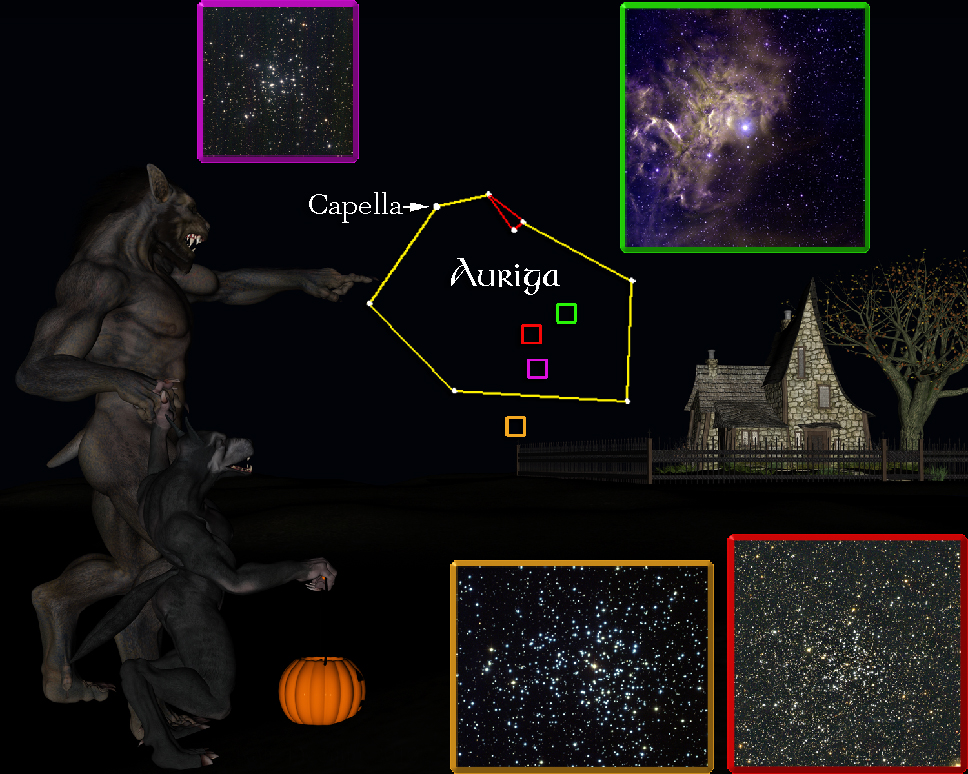
Auriga is easily found as a rough pentagon of stars marked by the night’s sixth brightest star, Capella, the She-Goat. Back in 1899, the Lick Observatory determined that Capella lies about 45 light years away and is actually a pair of giant stars orbiting around a common center of gravity. Further measurements determined that its component stars were about 70 million miles apart, about the distance separating the Sun and Venus. Scan to the right of Capella and you’ll come to a small triangle of stars that represent her baby goats, the Kids.
Looking at the constellation, you may notice that it contains some hazy patches of light where there are no visible stars. A set of binoculars shows the blurry lights in Auriga to be the beautiful open star clusters, M36, M37 and M38 (shown in the inset photographs arranged counter-clockwise from upper left). These clusters average a distance of some 4,000 light years from our Sun. It’s a bit of a shame that they’re so far away. If these stars were as close to us as other open clusters like the Big Dipper, our evening skies would be ablaze with hundreds of multi-colored stars brilliant enough to rival any of the very brightest.
The constellation of Auriga is also a temporary residence to “The Flaming Star”, one of the most unusual in our galaxy. I say temporary because this star, AE Aurigae, is only visiting this region; its original home was across the sky in the constellation of Orion, the Hunter. As a result of violent interactions between young stars, AE Aurigae was actually thrown out of Orion at high speed. In the millions of years that have since passed, the star has crossed a large stretch of interstellar space at a speed of 130 kilometers a second. Shown in the photograph at upper right, ensconced in a great complex cloud of glowing gases and dust, AE Auriga is a fairly luminous flare star that periodically surges in brightness. As it passed into Auriga and entered the region of gases, its ultraviolet radiation has made them fluoresce like a neon sign.
The photographs of M36, M37, M38 and AE Aurigae are from the National Optical Astronomy Observatory.
Unless otherwise indicated, all content of this web site is the copyright of Robert Deegan and all rights are reserved.
For more information, or to comment, please contact: Bob@NightSkies.org