
For the week including November 5, 2010
BEING IN TOUCH
The thought of people on Earth communicating with an intelligent alien civilization out there among the stars is an intriguing one. Of course there are many practical and complex problems that would need to be solved before any meaningful dialogue could be achieved. I’d have to rank finding an intelligent alien civilization to communicate with somewhere near the top. But even something as basic as time itself can be present a not-so-easy dilemma.
I recall a dinner with friends in one of Connecticut’s historic taverns. Decorating the walls of the dining room were common household objects used in New England a century or two ago. We passed the time between courses by trying to figure out what these devices were. We identified a few items, from cooking utensils and farm tools to the various components of a weaver’s loom. But as to the function of dozens of the other antiques we didn’t have a clue. Now, if a group of reasonably bright Earthlings are stumped by objects that would have been immediately recognizable just a handful of generations ago, what does that say about this planet’s ability to communicate with intelligent life forms in other regions of our galaxy when thousands of years might pass between messages sent and received?
Well, the difficulties haven’t stopped us from trying.
It’s been thirty-six years since the sending of the Arecibo message, one of our country’s better-organized attempts to converse with an extraterrestrial intelligence.
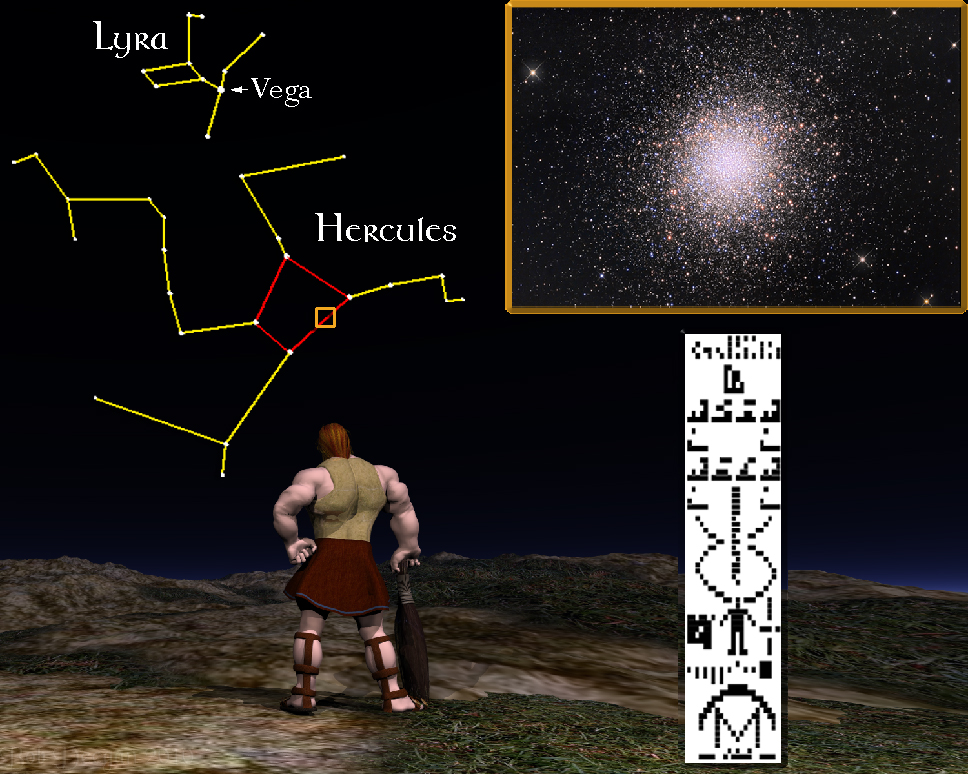
Back then, a group of astronomers and scientists led by Carl Sagan, used Puerto Rico’s Arecibo radio telescope to send a “universally understandable” message to M13, a dense ball of some quarter million stars. Their intent in targeting M13 was to hit a lot of stars (and their possible planets) at practically the same time. The message itself consisted of a repeating transmission that contained 1,679 bits of information. As most folks who receive these kinds of messages do, the aliens would instinctively recognize that since 1,679 is the product of two prime numbers, 73 and 23, we were asking them to lay out the signal in a grid of those dimensions. Once they did this, the message shown at the lower right would appear, giving them information about human biology, population, technology, and an erroneous idea of where we live. The model of our solar system shown underneath the message’s Frankenstein-ish human figure contains nine planets. Even back in 1974 most astronomers knew that it was very unlikely that Pluto was actually a planet and it has since been re-classified. All things considered though, it wasn’t a bad amount of information for a pretty brief signal and it almost completely avoided transitory cultural messages that could become confused over time. And there’s the catch. M13 is some 25,000 light years away, meaning that the message is going to take 25,000 years to get there. What happens if they’re in the shower, or we get the answering machine? And even if they respond right away, it’s going to take another 25,000 years for their message to reach us! It would take one heck of a research grant to cover that span of time. And with all the changes that could take place in our civilization during the intervals between messages, would we even be able to remember what we were talking about?If you’d like to take a look at M13 (shown in the Osservatorio MTM pistoia photograph at upper right), you’ll quickly find it in the constellation of Hercules. After sunset, turn to the northwest and you’ll find Hercules under the conspicuously brilliant blue-white star Vega, in the constellation of Lyra, the Lyre. The globular cluster, M13, is near the center of this constellation, in a group of four stars called The Keystone (highlighted in red). On a clear, moonless night, you can even see M13 with the unaided eye as a faint hazy patch of light.
Unless otherwise indicated, all content of this web site is the copyright of Robert Deegan and all rights are reserved.
For more information, or to comment, please contact: Bob@NightSkies.org