For the week including December 17, 2010
A WINTER SOLSTICE ECLIPSE
In February of 1504, Christopher Columbus ran into big trouble during his fourth voyage to the New World. He had careened his ships on the island of Jamaica for some much-needed repairs and to take on food and drinking water for his crews. Unfortunately, Columbus was not very polite in his attitudes toward the Jamaican natives whom he treated more as servants than hosts. As time wore on, the islanders became less and less friendly toward their uninvited guests. Eventually, they flatly refused to aid the Europeans. With his ship’s timbers rotten with worms and his men grumbling as they watched their food stocks dwindle, Columbus was faced with a disaster that threatened to doom not only his latest Voyage, but also the lives of everyone involved. He did have an ace up his sleeve that the natives didn’t know about and that came in the form of his ship’s tables and almanac. They predicted a lunar eclipse was coming for that region. On that fateful night, Columbus made a large show of anger and threatened to extinguish the Moon. When the eclipse began and the Moon darkened, resistance collapsed. Of course the Jamaicans were acquainted with eclipses, but not with a person who could summon them at will. They quickly agreed to re-provision Columbus and he was thus able to make his journey home.
In the early morning hours of Tuesday, December 21st, we have another opportunity to watch the grand spectacle of a total lunar eclipse. This happens when the Earth crosses between the Moon and Sun. The shadow cast by the Earth slowly envelops the Moon and causes the eclipse. Because the Moon orbits the Earth on a slight angle, this intersection doesn’t happen very often. This particular eclipse is happening on the day of the winter solstice, a rare enough event in itself, but in olden times an eclipse on the first day of winter was thought to predict very cold temperatures ahead for the season.
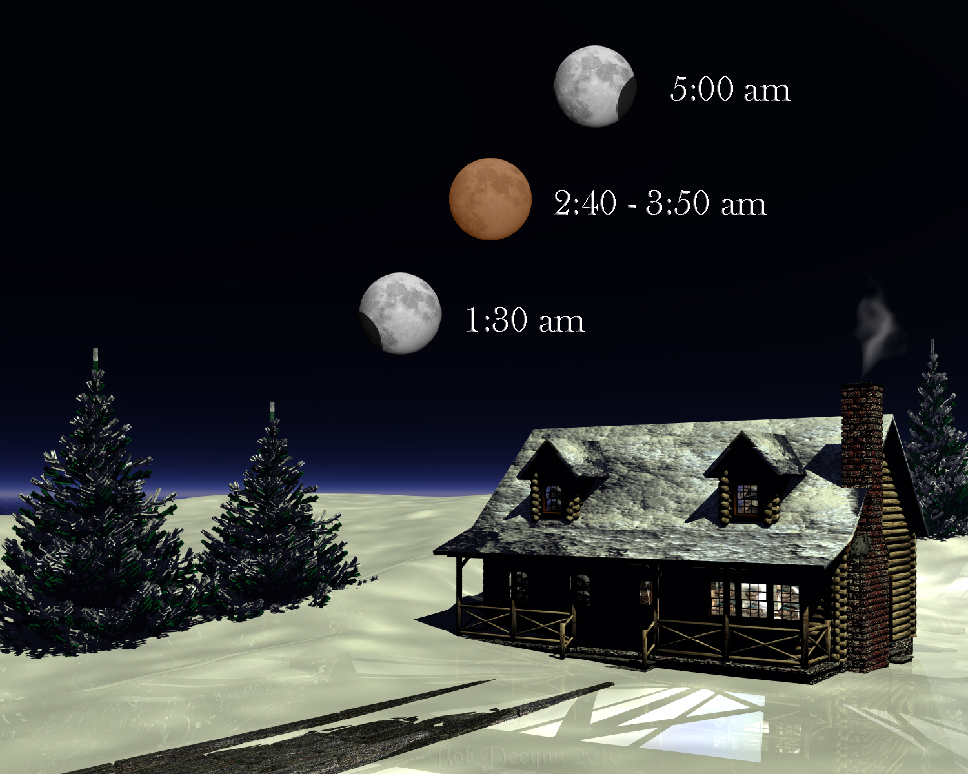
Technically, this eclipse will start at about 12:30am when the Moon, which will be high in the sky for most observers, crosses into the Earth’s penumbral shadow. (Please note: The times that I give here are for eastern standard time, so folks around the country can simply adjust the times given to that of their local zone. For instance, people in California [PST] would subtract three hours and so their event would begin at 9:30pm on Monday, December 20th. Also, to make things easier, I've rounded the chronology somewhat, because most viewers won't need ultimately precise times to fully enjoy the event.) The penumbra is a lighter shadow caused when the movement of the Earth prevents a portion of direct sunlight from reaching the Moon. As the Earth blocks more sunlight, the penumbral shadow deepens. Some lunar eclipses involve only a penumbral shadow and often go unnoticed by the casual observer because not enough sunlight is blocked to cause a discernable difference in the Moon’s appearance. To get an idea of how a lunar eclipse’s shadows are formed, see this diagram.At 1:30am, the Earth’s umbra shadow will appear on the side of the Moon. The umbra is the darker shadow of the eclipse and defines the area where direct sunlight is completely blocked by the Earth. The deep umbra shadow will slowly move across the face of the Moon. If you have a telescope, you can watch the dark shadow of the eclipse steal its way through lunar craters and mountain ridges.
At 2:40am, the Moon will be in its deepest eclipse and will have turned a nice orange-red color. This coloration is caused by sunlight passing through and being bent toward the Moon by the Earth’s atmosphere. We see similar colors caused by the bending of light toward the red end of our visual spectrum during normal sunrises and sunsets. This stage, the total eclipse will last a bit more than seventy minutes.
The Moon will pass out of the umbral shadow at 5:00am and re-encounter the partial shadowing of the penumbra. The eclipse will officially end around 6:00am when the Moon passes completely out of the Earth’s shadow. Do try and catch this lunar eclipse because the next one won't be available for the whole of North America until April of 2014. On the other hand, if it’s another winter solstice lunar eclipse that you would really like to see, there’s another one due up in 2094. Certainly that’s something worth hanging around for.
Unless otherwise indicated, all content of this web site is the copyright of Robert Deegan and all rights are reserved.
For more information, or to comment, please contact: Bob@NightSkies.org